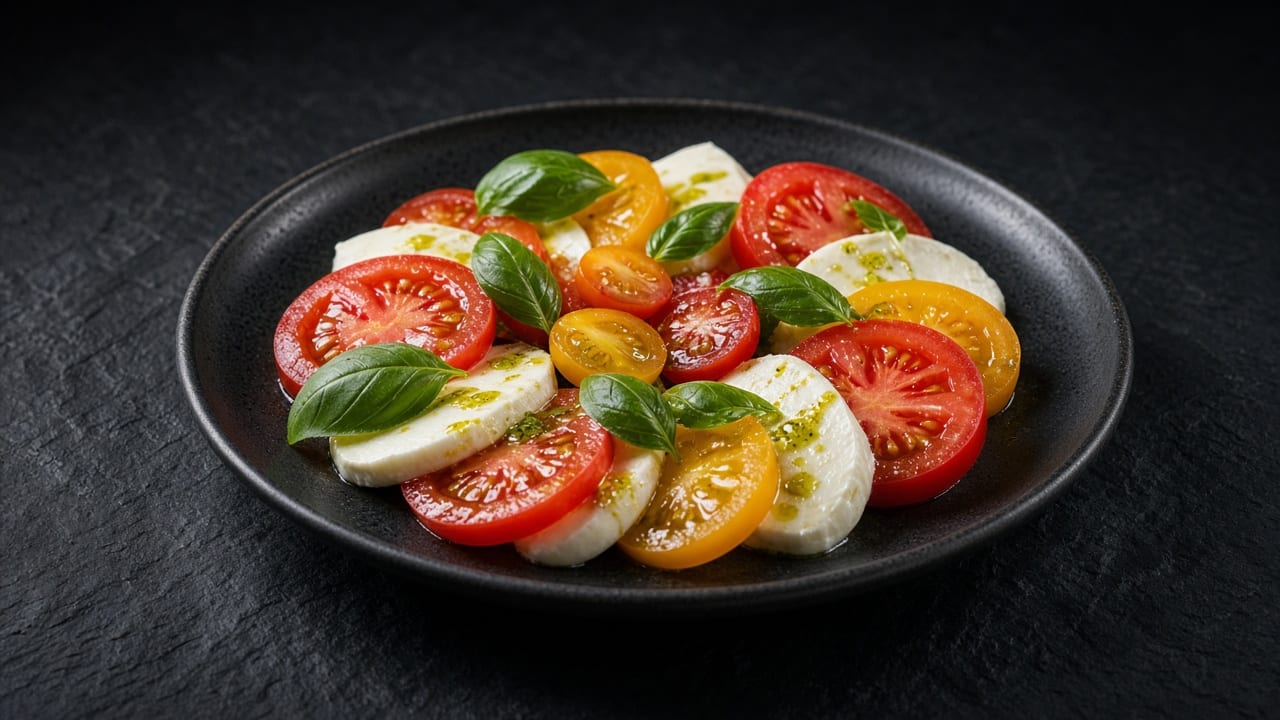
Tomato and Mozzarella Caprese with Basil
Inspired by techniques from NYT Cooking, Serious Eats and America's Test Kitchen.
A simple caprese of overlapping ripe tomato and mozzarella slices with whole basil leaves, finished with good olive oil. Letting the cheese lose its fridge chill before serving makes all the difference to its flavour.
Always check the labels of the products you use.
Method
- 1
Slice and rest the cheese. Slice the cold mozzarella about 1 cm thick, since it cuts far more cleanly straight from the fridge, then pat the slices dry with kitchen paper. Leave them covered for 20 minutes to come up to room temperature. Cold mozzarella tastes muted, so this short rest is what lets its milky flavour actually show through.
- 2
Slice and season the tomatoes. Cut the tomatoes into 1 cm slices on the board and season with half the salt. The salt draws out a little of the tomatoes' juice straight away, concentrating their flavour before they even reach the platter.
- 3
Layer the platter. Overlap the tomato slices, mozzarella slices and whole basil leaves in alternating rows across the platter. Pour over any juice that has collected on the board, as it's full of flavour and shouldn't be wasted. Aim for an even mix of colour and texture across the plate.
- 4
Season and finish. Scatter over the remaining salt and the pepper, then drizzle with the olive oil and tuck in a few extra basil leaves for freshness. Serve within 30 minutes so the basil stays bright and green rather than wilting against the warm tomatoes.
Storage
Best enjoyed fresh within 30 minutes of assembling. If you must keep leftovers, refrigerate within 2 hours and eat within 1 day; it doesn't freeze well and there's no cooking or reheating involved.
EU nutrition claims
- Source of protein: 4.8 g protein per 100 kcal, about 19% of energy (needs ≥ 12%)
- Low sugars: 2.1 g sugars per 100 g (limit ≤ 5 g)
Per 100 g of the finished dish, worked out from the nutrition per serving and the lowest likely cooked weight (about 224 g a serving), so the true values are, if anything, lower. Thresholds from the Annex to EU Regulation (EC) No 1924/2006. How we decide
Free sugars
0 g per serving
0 % of the 50 g daily maximum · 0 % of the ideal 25 g
Free sugars under 50 g a day, ideally about 25 g, based on WHO free-sugar guidance (not endorsed by WHO). The share shown is the share of one serving. WHO
Equipment
- chopping board and sharp serrated knife
- serving platter
- kitchen paper
Nutrition per serving (estimated values)
| Per serving | Amount |
|---|---|
| Energy | 315 kcal |
| Protein | 15 g |
| Carbohydrate | 7.6 g |
| of which sugars | 4.6 g |
| of which free sugars | 0 g |
| Fat | 25.7 g |
| of which saturates | 11.2 g |
| Fibre | 1.9 g |
| Salt | 1.86 g |
Protein per 100 kcal
4.8 g High Protein needs ≥ 5 g (20% of energy)
Calculated from USDA FoodData Central ingredient values